Summary
In the introduction of Seeing & Writing 3, the authors reiterate the idea that seeing plays a big role in writing and that, in fact, it's all a matter of seeing anyhow: "Well, letters are just little pictures. Look: I am writing. I am writing. But I am also drawing letters" (p. 2). Throughout the introduction, they address the entire writing process in a comprehensive format, with helpful examples and exercises.
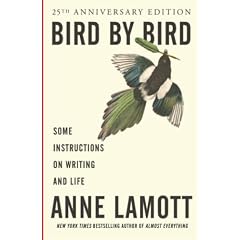
S&W v. Bird by Bird
While the presentation is not necessarily drier than that of LaMott's commentary on the writing process (The pictures help.), the tone is definitely much more didactic. The content in this book is clearly directed at college students in textbook form (including being just a bit more formal), whereas Bird by Bird seeks a broader scope of people (adults, in general) and is written in a much more relaxed tone of voice. For one thing, Bird by Bird is a lot more opinionated than Seeing & Writing 3. The authors also use different ways to get their message across. In Bird by Bird, LaMott uses anecdotes from her own personal experience. The authors of Seeing & Writing 3 use more general examples and offer illustrations and exercises.
Since we only read excerpts from LaMott's book, I cannot assume that LaMott only focuses on the virtue of first drafts, but I can say that the Introduction of Seeing & Writing 3 covers more concepts of the writing process, including other ways of finding content with which to work (i.e. brainstorming, editing along the way, outlines, etc.).
This is not so much a matter of which book is better or more interesting as it is a comparison between two sets of writing styles, purposes, and audiences.
Exercise pp. 10-11: Monster Zero Second Confession, Part 4
by Jay Snodgrass
"If you think a thought about yourself
And then you think a thought about yourself
Thinking about yourself thinking a thought
About yourself and so on, then
You can't stop seeing yourself through
Someone else's eyes, and ultimately you
Don't know who you are anymore because
You can't remember which of you looking at the other
Yous was the first one. And so the fragments look
Around, looking for the first and they grow
Multiply on themselves until they are a
Giant dinosaur-shape of mind-eyes looking.
This is how we split into fragments."
Observations
1. I notice that the poem consits of three sentences.
2. I notice that the sentences are sectioned off into six couplets and one line.
3. I notice that the turn occurs in the last line.
4. I notice that there is no rhyme scheme.
5. I notice that the only line containing hyphens is the second-to-last line of the poem.
6. I notice that after the caesura at the beginning of the fifth couplet, the poet cuts off the repetition of the idea of "you".
7. I notice that, while the subject in the poem is first addressed in second person singular, it shifts to third person plural and then first person plural.
8. I notice that the first part of the poem made me laugh.
9. I notice that the last part of the poem did not make me laugh.
10. I notice that while reading the first part of the poem, I did indeed think of a thought about myself thinking about myself thinking about myself thinking a thought about myself, and that it hurt my brain.
Inferences
1. Based on the observations I made, I infer that the poet intentionally put a break in line 9 and placed the last sentence in a line all by itself in order to emphasize the idea of fragments.
2. The shift in person and number, and the fact that "you" is not used after the shift from second person singular, enhances the idea of splitting into unrecognizable parts of oneself.
3. The tone of voice changes from lighthearted and whimsical to meditative and almost brooding.
4. While the mood suddenly changes at the turn of the poem, the question of "your" original identity is never answered. Therefore, the poem ends on a disconcerting note.