Monday, March 26, 2007

On Power

Possibly due to the very fact of her smaller role in The Kite Runner, in comparison to more major themes, Soraya’s part in the novel introduces a number of intriguing ideas about rules and structure in society.

What is it that decides one individual’s status over another’s? In many Asian countries, the female takes the backseat to matters of power, politics, finance, etc. However, life with the Amazons might prove much more accommodating to such types. As for money, or even intelligence, as the deciding factor in the “hierarchy” of man, it really all comes down to an established set of values. One could say, for instance, that the laboring man has more freedom than white-collared types, for those with more money tend to enslave themselves to material objects.

In this way, due to the very fact that Asian women are often overlooked as too simple to understand such things as politics or what have you – they are empowered. Given that they have the inner strength to themselves overlook such trivialities as public dissent and censure of new ideas, they have been given a very unique position with which to influence the world around them. Take, for example, any number of women:

Of legend:

* Helen of Troy – She started an entire ten-year war!!
* Sacagawea - She led an expedition of male explorers through long, dangerous terrain with child, helping them translate and find food.

In film:

* Holly Golightly - $50 a-piece for the “powder-room” (given 1960’s prices)? On looks and charm alone, Ms. Golightly had any number of rich, powerful men wrapped around her finger and available to even bail her out of prison.

In history:

* the Japanese geishas – Using their disarming feminine appeal, geishas wooed and coaxed their rich and influential benefactors into bending the world for them politically, financially, etc. In this way, many geishas had a leg-up with extra food stamps and in finding refuge during World War II.

* Queen Elizabeth I (of England AND Ireland) – Aside from her status as a rich and eligible bachelorette, her wit and wisdom lent her much power over diplomatic relations with other countries, as well as the welfare of the stage and its actors.

* Cleopatra – Seducing men everywhere for her own bidding.

* the First Ladies of the U.S.A. – You don’t really think those men do it all on their own, do you?

to name a few.

With their ability to flatter with delusions of power or hope or to toy with their emotions – break them, even – before they even know what hit them! (skills few men can manage, get away with, and still benefit from), women get much farther than many men will ever dream of realizing. This, I believe, is power.

Enter Soraya Taheri.

In Amir’s unstable condition, Soraya is just what he needs. Despite that she is a “mere” female in the male-dominated Afghan society, Soraya is the only one with the power to give him hope during Baba’s illness and hope for redemption. In her goodness and by example, she unwittingly gives Amir the courage to come to terms with his past. Furthermore, given that Amir has grown up without female influence in his life, save for the books his mother left behind, I think that the narrator very much needs this sort of nurturing figure in his life. In fact, just as the very manly Baba grew up without a father, I believe female influence will help Amir sort of balance himself out and learn to be more of a man.

On top of her power to give Amir agency in his emotional stability and spiritual well-being, she is given the power to improve her own condition – partially through the fact that Amir needs her. Thus, her beauty, her gender, and her kind-hearted mien have already allowed her this advantage, which she needs, because her tainted past has previously limited her agency. This especially, because her gender is also a more obvious limit on that agency: “Baba knew how lethal idle talk could prove to a young woman’s prospects of marrying well” (148).

The fact that her reputation is far easier to soil than that of her contemporary male is another limiting factor that tightens that particular restriction on her life. Amir acknowledges this saying, “I was fully aware of the Afghan double standard that favored my gender” (146) “… because I had won at the genetic lottery that had determined my sex” (149). Still, very much so because of her family’s relocation to the United States, though she remains within the Afghan community in California, she gains a couple more advantages.

Having moved to America as a preteen, Soraya is young enough to quickly pick up English, as well as keep her native tongue. Therefore, she is fluent in two different languages, which is a big advantage, especially because she is in California and wants to become a teacher. In fact, she has already taken advantage of this ability, having become ESL certified and currently teaching at the public library once a week, thus being given the opportunity once again to give agency to others. Also, because she lives among two very different societies of people, Soraya is given a unique, more open-minded perspective on the world. This mindset will undeoubtedly help her to connect with others to whom she will give agency through education.

The fact that Soraya now lives in America also gives her equal rights – legally, anyhow. She also has the opportunity to receive an equal level of public education and an equal access to secondary education. She can even choose her own major.*

So, maybe sometimes people just really have to use their resources. Maybe their station in life just needs a new value system or a new perspective.**


* In Malaysia, for instance, Chinese people (as opposed to Malays) rarely get the chance to decide the course of their lives once they are admitted into a university. Getting in is tough enough and super-competitive. Once you’re in, the counselor gives you a random major neither based on choice nor skill. You either take it or go home. My female cousin is majoring in chemical engineering, which is fine; I just am not so sure she would have picked the same major, given the choice …

** Hey, not that I SUPPORT female oppression or anything.

Wednesday, February 14, 2007

"The Cosmic Significance of Britney Spears"

In Tom Perrotta’s outdated article “The Cosmic Significance of Britney Spears”, the man contends that Britney matters enough to the world to represent a whole era of American history, “a potent symbol of the late ‘90s” (572-573) as he’d like to call her.

He pits her up against actual larger-than-life icons like Elvis, Madonna and Kurt Cobain in an effort to liken her to a great music personality using such arguments as “[Elvis and Britney] both grew up in … the Deep South” (569). That’s great, really. Luckily, he’s not a complete sucker for big boobs and the “innocent” act (I ask you, reader, how many women would approach the subject of Britney Spears’s “Cosmic Significance” in quite the same way?).

Though he discusses her qualities with a sense of pseudo-seriousness, the author does not respect her as an equal or higher. It is evident in his choice of Britney quotes throughout the article: “But this time [a stupid knee injury] was her mountain to climb alone” (572), mourns Britney’s mother. In the next paragraph, Britney is quoted as mentioning her “amazing team of writers, musicians, and producers” and her gratefulness to them for “churning out great songs for me”. She does nothing with the music but to spit out the manufactured product like some mindless robot. This idea is further engaged by Britney’s confession about her choreography practice sessions: “I will practice and practice a move in front of a mirror, over and over again – ten, twenty, a hundred times – until I’m happy with it.”

However, he’s still got it all wrong. Perhaps, given the chance to re-examine the situation in a later article, he might today take back his unintentional insult to Oprah and Madonna that one would even dream of believing that Britney is “a one-name trademark on par” with these two women.

Whether or not I respect, or even like Britney Spears is irrelevant. One needn’t be liked or respected in order to be an icon. They must, however, be about something. They must have something that makes them stand out amongst the rest of the other pop icon prospectives. Even the author of the article admits that, “Britney had a musical identity imposed on her. Britney is the universal that was never particular” (570).

So, let’s have a break-down of Britney Spears. What is it that makes her special? Is it the big boobs? Hardly! Britney is far from the only person with a set of silicone balls on her chest. Hm, ok how about the original songs? No. The “innocent” persona? She lost that a long time ago, and anyhow, Mandy Moore does a better job at being wholesome than her.

The strongest point that Perrotta makes for Britney as a symbol is that “The whole point of the new-economy boom was that you could be rich and powerful right now, while you were still young and good-looking” (573). I resent this, because the idea implies a new set of principles completely contrary to the American Dream. Success in America isn’t supposed to be about innate talents and good looks. It is supposed be based on hard work.

Furthermore, whether or not you live on past your self-defining era – yes, I agree that “The big question for Britney right now isn’t whether she can make a Madonna-like transition into adult stardom” (573) - one must withstand the test of time. While Britney has definitely “reinvented herself” a number of times, she in no way “managed to stay a success for so long while other artists have fizzled out” (570). Britney has faded and gone to pop star hell amongst the B-class paparazzi and maybe the back pages of tabloids – if there is any space. Without the teasing good-girl image, and given her various failed marriages (Yea, “chastity until marriage” (569) means a whole lot less when you just get married every time you want to have sex.), she’s just any other teen pop slut. Also, one’s character and other people’s idea of that character can be immensely influenced by the connections one chooses to build and the relationships that result. So, it really does no good to Britney that her last two publicized “beaus” were a pair of effeminate wannabe Eminems.

Besides, the bookends illustration of Cobain v. Britney (572) is unfair. There is only a section of 90’s America that took note of Britney Spears: little impressionable pre-teen girls and a rivaling fan base of perverts.

So, I’d hope, for humanity’s sake, that she isn’t “one of those … figures whose job it is to tell us who we are and where we’re going” (569). I refuse to allow such a bimbo to stand for my childhood days.

Wednesday, January 31, 2007

S&W pp. 121-124 (Millhauser, Bryson, and Sagan)

Steven Millhauser's argument that "all forms of distortion shock us into attention" (121) is supported by Bryson and Sagan on both a teensy scale and an infinitely huge one, respectively.

Bill Bryson suggests that life is a highly improbable miracle. He claims that we should feel extremely lucky to even be alive. The whole essay is very uplifting and aims (and succeeds, in my case) to incite in readers that passion for life, which is oh-so-short, but sweet. I’ve never heard someone read into science with such poetry. I absolutely adored the introduction: “Welcome. And congratulations, I am delighted that you could make it. Getting here wasn’t easy, I know. In fact, I suspect it was a little tougher than you realize." The way in which Bryson describes the atoms and gives them a life of their own, explaining that, “For all their devoted attention, your atoms don’t actually care about you – indeed, don’t even know that you are there. They don’t even know that they are there,” (122) makes me suspect that even inconsequential me might be part of a bigger scheme about which I am unaware.


The more cynical Sagan proposes the same idea that the idea of life deserves its due respect and wonder, but in the very contrary sense. The world is, in fact, a little “mote of dust suspended in a sunbeam” (124) which generations upon generations of individuals have called home. We need not protect ourselves against the world so much as we must take "responsibility to deal more kindly and compassionately with one another and to preserve and cherish that pale blue dot, the only home we've ever known".

When we are all such a small part of such a small world in the grand scheme of things, how can “all those generals and emperors” justify their feeling of self-importance by feuding over this mere “fraction of a dot”? This idea reminds me of Owen Wilson’s character leading his little men against the Roman forces in the movie “Night at the Museum”, because they have a “delusion that we have some privileged position in the universe”. Comparing this against Sagan’s “Reflections”, I now wonder if Ben Stiller’s reaction to the little people as little misled children might somewhat resemble God’s response to mankind.

Wednesday, January 24, 2007

Seeing & Writing: Introduction


Summary
In the introduction of Seeing & Writing 3, the authors reiterate the idea that seeing plays a big role in writing and that, in fact, it's all a matter of seeing anyhow: "Well, letters are just little pictures. Look: I am writing. I am writing. But I am also drawing letters" (p. 2). Throughout the introduction, they address the entire writing process in a comprehensive format, with helpful examples and exercises.

S&W v. Bird by Bird

While the presentation is not necessarily drier than that of LaMott's commentary on the writing process (The pictures help.), the tone is definitely much more didactic. The content in this book is clearly directed at college students in textbook form (including being just a bit more formal), whereas Bird by Bird seeks a broader scope of people (adults, in general) and is written in a much more relaxed tone of voice. For one thing, Bird by Bird is a lot more opinionated than Seeing & Writing 3. The authors also use different ways to get their message across. In Bird by Bird, LaMott uses anecdotes from her own personal experience. The authors of Seeing & Writing 3 use more general examples and offer illustrations and exercises.

Since we only read excerpts from LaMott's book, I cannot assume that LaMott only focuses on the virtue of first drafts, but I can say that the Introduction of Seeing & Writing 3 covers more concepts of the writing process, including other ways of finding content with which to work (i.e. brainstorming, editing along the way, outlines, etc.).
This is not so much a matter of which book is better or more interesting as it is a comparison between two sets of writing styles, purposes, and audiences.

Exercise pp. 10-11: Monster Zero Second Confession, Part 4
by Jay Snodgrass


"If you think a thought about yourself
And then you think a thought about yourself

Thinking about yourself thinking a thought
About yourself and so on, then

You can't stop seeing yourself through
Someone else's eyes, and ultimately you

Don't know who you are anymore because
You can't remember which of you looking at the other

Yous was the first one. And so the fragments look
Around, looking for the first and they grow

Multiply on themselves until they are a
Giant dinosaur-shape of mind-eyes looking.

This is how we split into fragments."


Observations
1. I notice that the poem consits of three sentences.
2. I notice that the sentences are sectioned off into six couplets and one line.
3. I notice that the turn occurs in the last line.
4. I notice that there is no rhyme scheme.
5. I notice that the only line containing hyphens is the second-to-last line of the poem.
6. I notice that after the caesura at the beginning of the fifth couplet, the poet cuts off the repetition of the idea of "you".
7. I notice that, while the subject in the poem is first addressed in second person singular, it shifts to third person plural and then first person plural.
8. I notice that the first part of the poem made me laugh.
9. I notice that the last part of the poem did not make me laugh.
10. I notice that while reading the first part of the poem, I did indeed think of a thought about myself thinking about myself thinking about myself thinking a thought about myself, and that it hurt my brain.

Inferences
1. Based on the observations I made, I infer that the poet intentionally put a break in line 9 and placed the last sentence in a line all by itself in order to emphasize the idea of fragments.
2. The shift in person and number, and the fact that "you" is not used after the shift from second person singular, enhances the idea of splitting into unrecognizable parts of oneself.
3. The tone of voice changes from lighthearted and whimsical to meditative and almost brooding.
4. While the mood suddenly changes at the turn of the poem, the question of "your" original identity is never answered. Therefore, the poem ends on a disconcerting note.


Tuesday, January 23, 2007

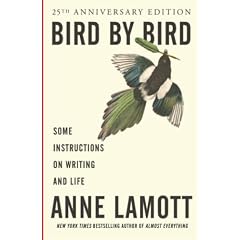
Excerpts: Bird by Bird


Using a playful tone of voice that's lots of fun, Anne LaMott engagingly develops the idea of the writing process as a medium between people and their inner selves. With such a tasteful use of expletives that I've never seen in any other piece of literature, LaMott notes the irreplaceable value of a "shitty first draft". In her chapter on school lunches, LaMott demonstrates how the little people that emerge from free writing may very well end up being the ones that stand out to the author. She believes that "writing a first draft is very much like watching a Polaroid develop" (p. 39). Once you get going and let it all out on paper, no matter how unfocused or pin-pointedly focused you think your thoughts are, you'll be surprised at how the picture slowly turns out. Whether it gains in shape, color, purpose, or a few extra details, gathering one's thoughts on paper through that first draft is an essential part of the writing process as a passive activity; the writer must allow his/her mind to roam free if they want to get the most out of it.

In "Shitty First Drafts", the author reveals that it's okay to spout crap the first time around; it isn't so easy for anyone: "The right words and sentences just do not come pouring out like ticker tape most of the time" (p. 22). In fact, according to her chapter titled "Polaroids", you don't even really have to have an idea of how your paper will end up looking. When the "grayish green murk" begins to take shape, it will be clear to you just what you need to do.

A lot of the stuff that she says, like "Just get it all down on paper", might sound like common sense, but honestly I've always been so daunted by writing assignments that I've never even considered these tips. However, Anne LaMott's laidback tone of voice helps me relate. Also, the fact that she allows her voice to shine through her writing about writing exemplifies her own ideas put into practice.